
- Catalogues
- Envira
- Nanoenvi IAQ Fitness centers


Nanoenvi IAQ Fitness centers
Nanoenvi IAQ Fitness centers
La qualité de l'air intérieur est cruciale pour les activités physiques en salle. Un suivi adéquat de cette qualité est essentiel pour garantir un environnement sûr et sain pour les sportifs.
Les gymnases peuvent être considérés comme des espaces sûrs pour le sport uniquement si la qualité de l'air intérieur est bien surveillée. Les villes sont souvent polluées par des gaz de combustion de véhicules et des particules. En intérieur, la qualité de l'air peut être contrôlée, ce qui attire les athlètes qui ne peuvent pas bénéficier de cette possibilité à l'extérieur.
La qualité de l'air dans un gymnase est déterminée par des paramètres tels que le CO2, les COV, les PM et le CO. Une bonne qualité de l'air est essentielle pour maximiser l'oxygène disponible, crucial pour l'activité cérébrale et musculaire.
Les installations sportives présentent souvent des concentrations élevées de particules et de composés organiques volatils, pouvant causer des irritations et des maladies respiratoires à long terme. Le CO2, bien qu'indicateur important, doit être complété par d'autres mesures pour garantir une bonne qualité de l'air.
Les conditions hygrothermiques optimales sont nécessaires pour maximiser la performance sportive. Une température idéale se situe entre 20º et 22º. Une humidité excessive peut entraîner une sensation d'air lourd et des odeurs désagréables.
La surveillance de la qualité de l'air est un atout majeur pour un centre de fitness, permettant d'agir avant que les utilisateurs ne ressentent des problèmes. Cela distingue les centres qui prennent soin de cet aspect de ceux qui ne le font pas.
Nanoenvi est un dispositif Wifi facile à installer et sans entretien, qui surveille de manière fiable les paramètres déterminant la qualité de l'air intérieur. Il transmet des données en temps réel et dispose d'un système d'alerte pour corriger rapidement les situations problématiques. L'appareil affiche l'indice de qualité de l'air via un panneau LED avec quatre états identifiables par des couleurs.
Extraits du catalogue
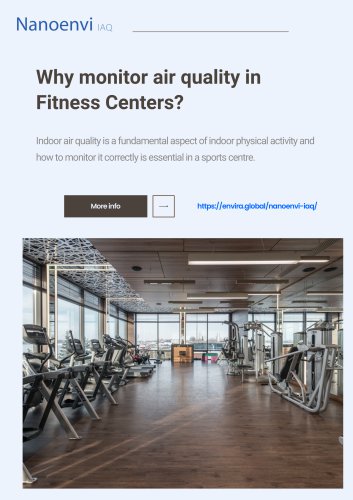
Why monitor air quality in Fitness Centers? Indoor air quality is a fundamental aspect of indoor physical activity and how to monitor it correctly is essential in a sports centre. More info
Ouvrir le catalogue en page 1
1. Indoor vs. outdoor physical activity In or Out, What's best? A Gym may advertise that it is a safe space for practising sports compared to outdoor only if indoor air quality is properly monitored. Cities are highly polluted with gases from vehicle combustion, such as CO and other substances such as particulate matter. Outdoor air can't be filtered, so in a closed space such as a gym or fitness centre, the ability to influence air quality can be used to attract athletes who wouldn't be able to take advantage of this when exercising outdoors. To ensure indoor air quality it must be monitored
Ouvrir le catalogue en page 2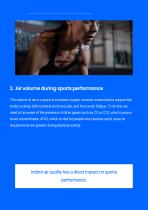
2. Air volume during sports performance The volume of air in a space is constant, oxygen must be maximised to support the body's activity, both cerebral and muscular, and thus avoid fatigue. To do this we need to be aware of the presence of other gases such as CO or CO2, which cause a lower concentration of O2, which is vital for people who practise sport, since air requirements are greater during physical activity. Indoor air quality has a direct impact on sports performance.
Ouvrir le catalogue en page 3
The air quality in a gymnasium or sports centre and in general in any indoor environment is determined by the following parameters. Sports facilities contain hight concentrations of particulate matter (dust, aerosols...) and Volatile Organic Compounds. Both pollutants are inhaled by the user and reach the lungs and can cause throat, nose and eye irritation during physical activity. . Long-term exposure may even lead to the development of more serious respiratory diseases and pathologies. Measuring these types of parameters allows us to identify deficiencies in ventilation procedures or if it...
Ouvrir le catalogue en page 4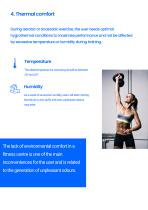
4. Thermal comfort During aerobic or anaerobic exercise, the user needs optimal hygrothermal conditions to maximise performance and not be affected by excessive temperature or humidity during training. Temperature The ideal temperature for exercising should be between 20º and 22º. Humidity As a result of excessive humidity, users will start noticing that the air is very stuffy and even unpleasant odours may arise. The lack of environmental comfort in a fitness centre is one of the main inconveniences for the user and is related to the generation of unpleasant odours.
Ouvrir le catalogue en page 5
5. Distinction Monitoring and being able to guarantee the quality of the air in a fitness centre is an important distinction compared to other sports centres that do not take care of this aspect. Measuring air quality on a continuous basis allows us to act in a timely manner before the user can even notice any of the problems described in this document.
Ouvrir le catalogue en page 6
How does Nanoenvi IAQ measure air quality? Nanoenvi is an easy-to-install, maintenance-free Wifi device which main function is to reliably monitor the parameters that determine indoor air quality in order to improve the air renewal. Real-time data transmission and alert system to be able to amend the situation.
Ouvrir le catalogue en page 7
Device + platform + alerts Facility staff will be notified through the alert system whenever an area of the fitness centre has an air quality problem. The device also displays the air quality index by means of an LED panel based on 4 states which can be identified by the following colours: • Optimum: air quality is excellent. • Good: air quality is within recommended parameters. • Moderate: actions recommended to ensure that air quality is not compromised. • Poor: air quality parameters do not meet minimum values and measures such improving ventilation are needed.
Ouvrir le catalogue en page 8Tous les catalogues et fiches techniques (PDF) Envira
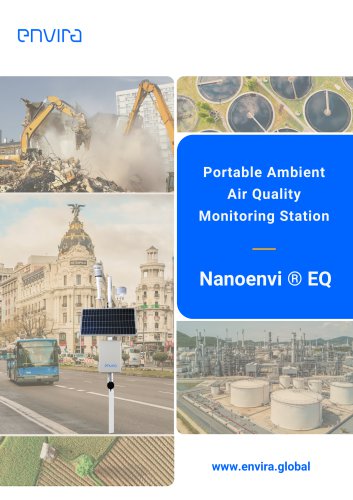 Catalogue Nanoenvi EQ
20 Pages
 Fiche technique IAQ
19 Pages
 Catalogue IAQ
4 Pages
 NANOENVI eqPM
2 Pages
 UrVAMM
2 Pages
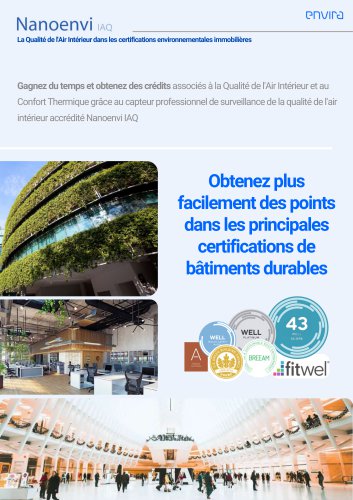
- Logiciel d'automatisation
- Solution logicielle de gestion
- Logiciel de process
- Logiciel temps réel
- Solution logicielle cloud
- Logiciel de commande
- Logiciel de supervision industriel
- Solution logicielle industrielle
- Logiciel de qualité
- Solution logicielle de simulation
- Logiciel automatisé
- Module de surveillance en temps réel
- Module de surveillance de mesure
- Module de surveillance de température
- Module de surveillance en continu
- Système de surveillance de l'environnement
- Logiciel haute performance
- Module de surveillance numérique
- Logiciel de stockage
- Système de surveillance de production